
The Velocity Hunters project focuses on designing and developing a CanSat mini-satellite capable of collecting and analyzing atmospheric and flight data during descent. The mission aims to study the behavior of small probes entering the atmosphere and to explore technologies that could support future interplanetary missions and planetary colonization. The CanSat will ultimately be launched to an altitude of approximately 2,500–3,500 meters, whereupon it will begin recording environmental parameters such as temperature, pressure, humidity, airborne particle concentration, acceleration, and terminal velocity. The collected data will be transmitted in real time to a ground station for analysis and visualization.
Construction design
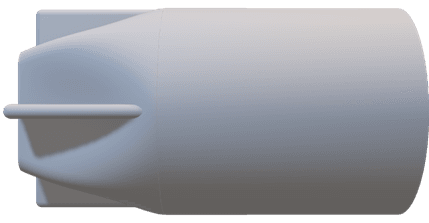
The mini-satellite frame is entirely 3D printed, which ensures its strength while maintaining low weight. Stabilizing “fins” are integrated into the design to maintain proper orientation during descent. The mechanical design does not contain any moving parts, which simplifies construction and increases reliability. The parachute system will use a nylon canopy with a central vent to improve stability during descent. The parachute will be deployed by melting fluorocarbon fishing line using a MOSFET-controlled resistor, insulated for safety with fiberglass wool.
Electronics design
The main control system is based on an Arduino M0 microcontroller from the CanSat Kit. The power supply consists of a 3.6 V lithium-ion battery connected to a step-up converter, which maintains a constant output voltage of 5 V for all components, ensuring proper operation and safe opening of the parachute. CanSat communicates with the ground station via LoRa radio modules, providing a reliable long-range connection for real-time data transmission.
The main sensors for the mission include a BME280 digital sensor, which measures temperature, pressure, and humidity.
Additional mission sensors include a six-axis MPU6886 IMU sensor for measuring acceleration and orientation, a GPS module for altitude measurement and recovery, and a PMS3003 sensor for detecting dust particles in the air.
Software design
The software will be developed in C++ using the Arduino IDE or Visual Studio Code with the PlatformIO extension. It will be responsible for data collection, processing, and communication with the ground station. The software will record sensor readings, manage data transmission, and control the moment the parachute opens. The ground station system, in turn, processes the received data to generate graphs and analyze flight parameters such as final speed and environmental changes during descent.
Communication and recovery systems
Communication between the mini-probe and the ground station is based on LoRa radio transmission, ensuring long range and stable data exchange. The recovery system is based on GPS coordinates transmitted after landing, which allows access to the location via mapping applications. A buzzer and a visible parachute will help locate the CanSat probe once it reaches the ground.
Project implementation
The project includes a detailed series of tests to check each subsystem—from parachute deployment and communication range to energy consumption and sensor accuracy. These tests will be conducted under controlled conditions to ensure safety and reliability.
Publicity and the aim of the project
As part of this project, the team aims to explore the potential of CanSats as small, inexpensive, and environmentally safe research probes that could play a role in future planetary missions. By measuring atmospheric properties and terminal velocity, it will be possible to contribute to understanding how renewable energy can be used on other planets and how descent systems can be optimized to ensure safe landing.
The Velocity Hunters team publishes information about its progress on social media (described below) in order to connect with other space exploration enthusiasts and inspire future engineers and scientists to reach for the stars.
Their Instagram: Velocity Hunters
Their X profile: Velocity Hunters
Their YouTube channel: Velocity Hunters
Their Facebook page: Velocity Hunters